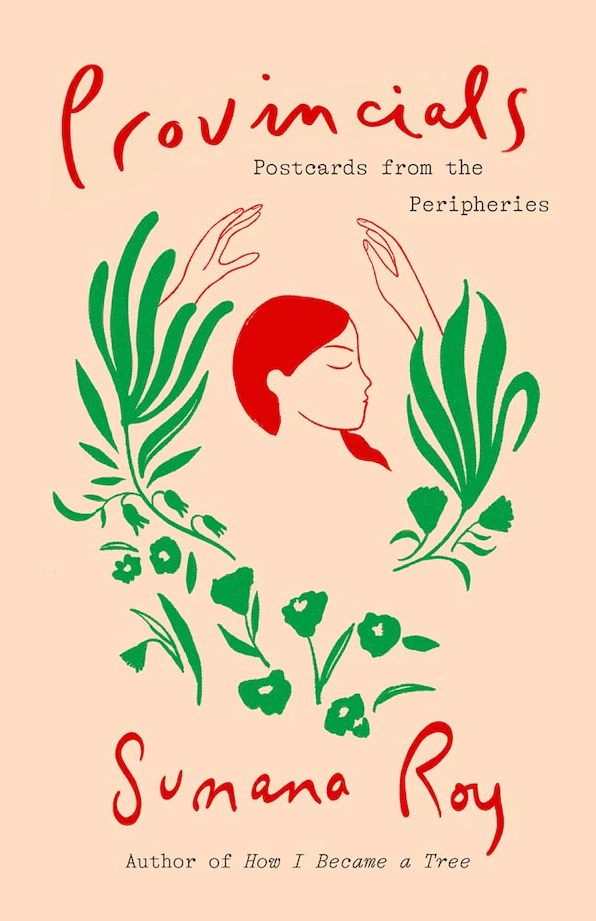
I was honored to copyedit a book coming out in spring 2024—Provincials by Indian writer, poet, and scholar Sumana Roy. This is a fascinating book and a difficult one to summarize, but the publisher’s description does it admirably:
An enchanting and joyous exploration of life and creativity at the geographical edges of the modern world
Who is a provincial? In this subversive book, Sumana Roy assembles a striking cast of writers, artists, filmmakers, cricketers, tourist guides, English teachers, lovers and letter writers, private tutors and secret-keepers whose lives and work provide varied answers to that question. Combining memoir with the literary, sensory, and emotional history of an ignored people, she challenges the metropolitan’s dominance to reclaim the joyous dignity of provincial life, its tics and taunts, enthusiasms and tragicomedies.
In a wide-ranging series of “postcards” from the peripheries of India, Europe, America, and the Middle East, Roy brings us deep into the imaginative world of those who have carried their provinciality like a birthmark. Ranging from Rabindranath Tagore to William Shakespeare, John Clare to the Bhakti poets, T. S. Eliot to J. M. Coetzee, V. S. Naipaul to the Brontës, and Kishore Kumar to Annie Ernaux, she celebrates the provincials’ humor and hilarity, playfulness and irony, belatedness and instinct for carefree accidents and freedom. Her unprecedented account of provincial life offers an alternative portrait of our modern world.
I loved Roy’s verve and humor throughout the book. As a native English speaker, I never fully grasped the significance and effects of the dominance of English throughout the world and the difficulty that nonnative speakers can have in learning the language, which is often a prerequisite to “be a part” of urban, elite, or simply popular culture. But the book shows too, or at least it showed me, that native English speakers and city dwellers may be unaware of other languages, other cultures, other writers and poets and philosophers, even just other people—individuals whose lives are different from theirs because of geographic and cultural location—in overlooked places of the world. Overlooked, that is, by those who aren’t looking. And this book helps us see.
Some experiences give us a sense that the world is small. This book had the opposite effect on me: there is so much of the world that I know nothing about.
 Davis Editing
Leave a comment